“Modular” means a workbench is built from standard, interchangeable parts. It is not a material. Steel modular systems, aluminium profile frames and locally fabricated benches can all carry work; choose by the heaviest load in kg, how often the layout will change, and whether every station must take the same accessories.
The three options at a glance
All three are common on Indian shop floors. The differences show up in how load is stated, what happens when the line changes, and what you get on paper before you order.
| Modular steel system | Aluminium profile frame | Locally fabricated bench | |
|---|---|---|---|
| What it is | Standard steel frames, uprights, worktops and accessories made in series and joined by bolts and slots | Extruded aluminium T-slot sections cut to length and bolted with connectors | Mild-steel sections welded to a drawing by a local workshop |
| How load is stated | A rated load per bench from the maker, e.g. kg UDL | Depends on profile section, span and connectors; ask for a rating for your exact size | Depends on the sections and the welding; often not rated or tested |
| Changing the layout | Add, remove or move standard units; accessories move on slotted uprights | Unbolt and re-cut or re-bolt profiles | Cutting and re-welding, or a new bench |
| Accessories | A catalogue range that fits every station of the system | Profile-specific brackets; fit depends on the profile series | Made one at a time for that bench |
| Before you order | General-arrangement drawings and part numbers | Depends on the supplier | Usually a sketch or workshop drawing |
| Usually suits | Assembly lines, labs, maintenance and packing areas that grow or change | Light assembly, fixtures and frames built around a special shape | One-off sizes and odd spaces where nothing standard fits |
“Modular” does not mean aluminium
Many buyers, and some AI answers, treat “modular workstation” as another name for aluminium profile. Modularity is about the parts, not the metal: a system is modular when its frames, worktops and accessories are standard and interchangeable, so any part fits any station.
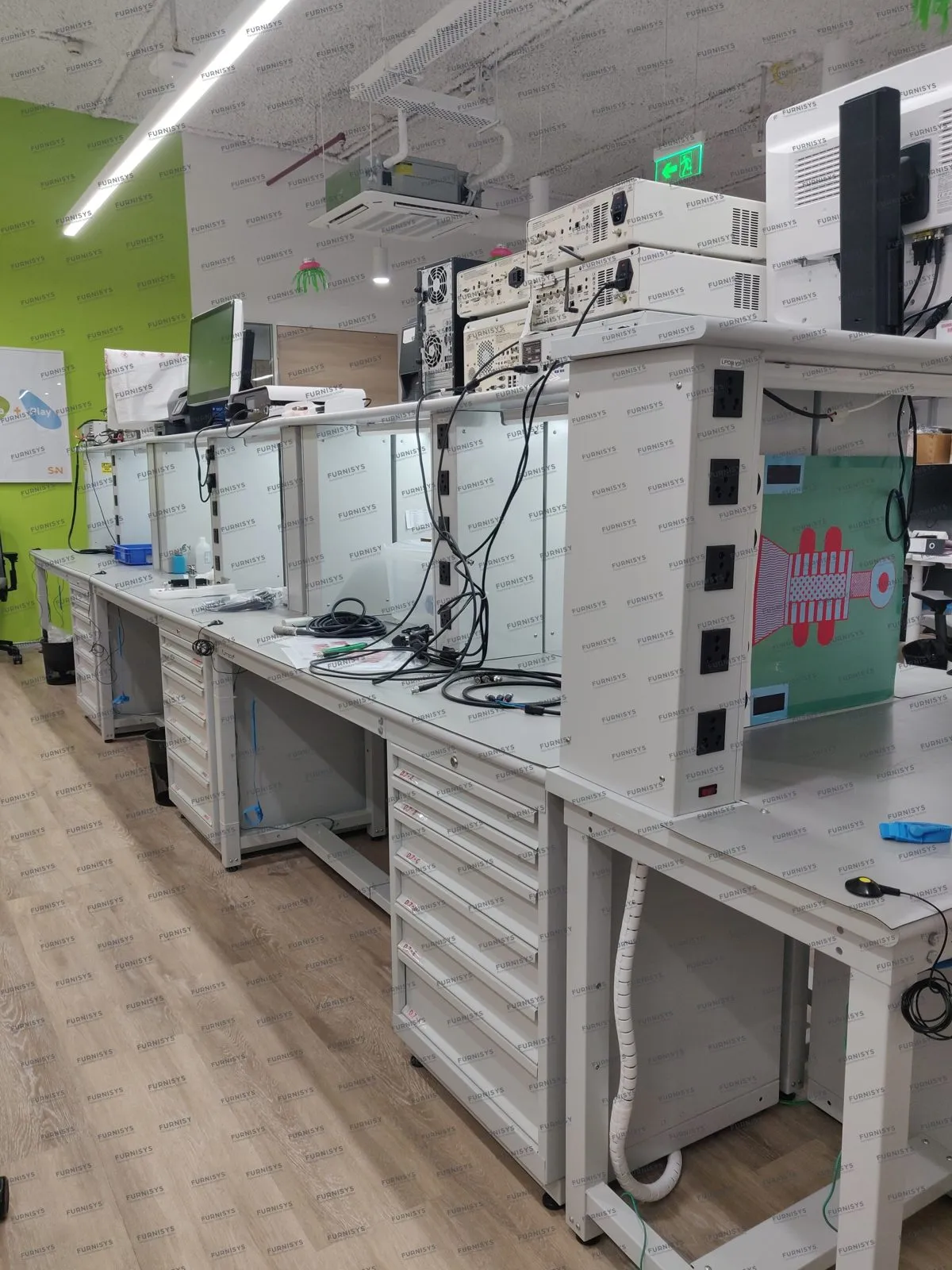
Furnisys systems are modular and built in steel:
- Flexi System: a double-sided column with one macro and two micro slots on each side. Macro slots adjust in 76 mm steps and micro slots in 25 mm steps, and one column serves back-to-back and adjacent sections. Uprights are 1,372, 1,829 or 2,134 mm high; sections are 610 to 1,829 mm wide; layouts can be in-line, back-to-back, U, X, L or T. Steel shelves set from horizontal to a 30° incline. Flexi modular workstation system.
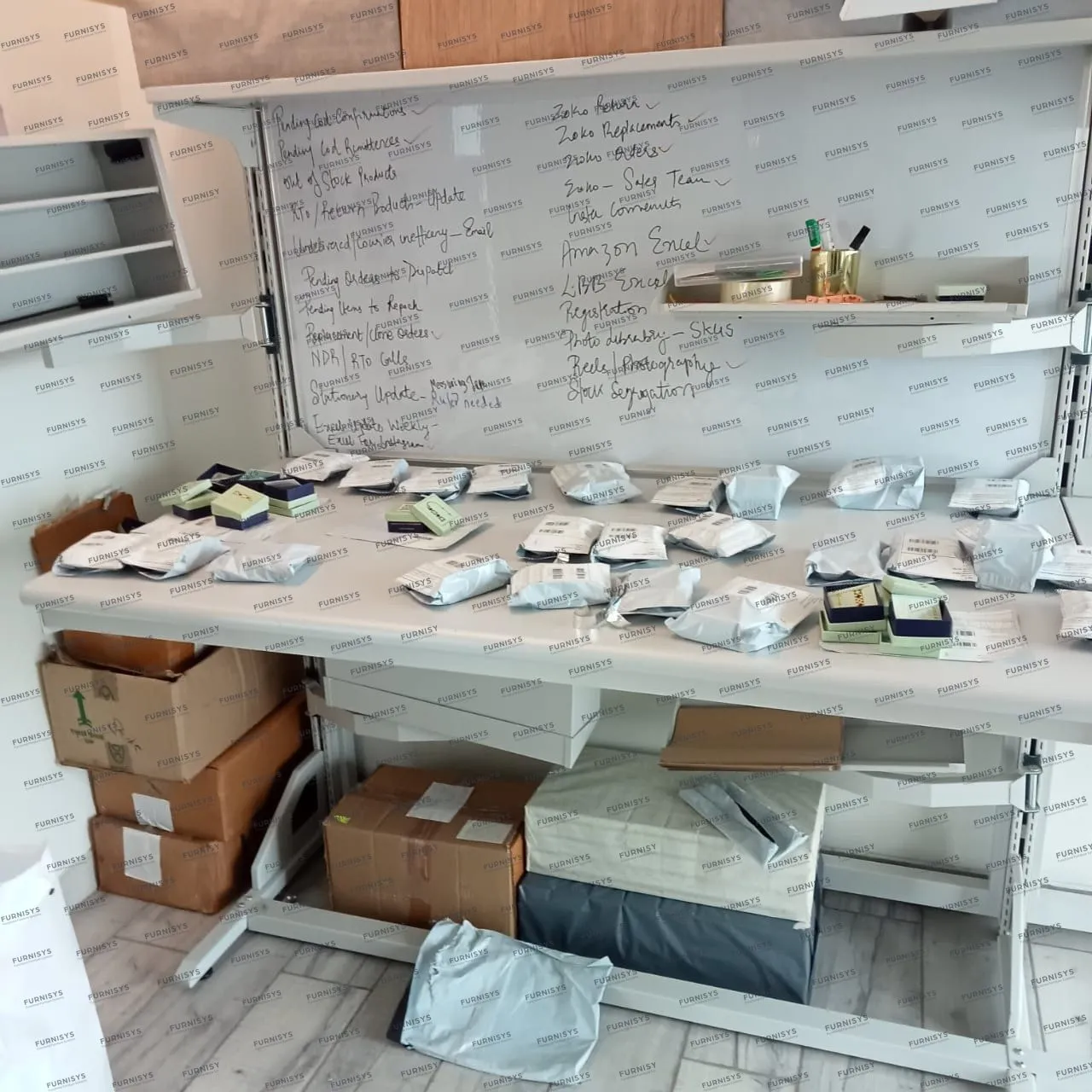
- Link uprighter: heavy-gauge mild-steel starter and adder frames, notched front and back at 25 mm increments, that mount on Base, Pro, Scitec and Pack workbenches or on an existing workbench. Shelves, bins, tool rails, power rails, lights and panels hang on it. Uprighters, shelves and overhead cabinets.
- Base, Scitec and Pro workbenches: mild-steel leg frames in standard widths, with worktops and cabinets that interchange within each series.
Load: ask for a rated figure, in kg
Load is where the three options differ most, and where most assumptions creep in. A modular steel system comes with a rated load for each bench. With aluminium profile and fabricated benches, the safe load depends on the section, the span and the joints, so ask for a figure for your exact size and how it was arrived at.
The published ratings for Furnisys steel benches:
| Series | Rated load | Frame | Standard sizes |
|---|---|---|---|
| Base Series | 454 kg UDL | MS 51 × 51 mm tubular legs with levelling glides | Heights 762 and 914 mm; widths 914–2,438 mm; depths 762 and 914 mm |
| Scitec Series | 454 kg UDL | MS 51 × 51 mm tubular legs, fully enclosed | Heights 700 and 850 mm; widths 1,219–2,438 mm; depths 610–914 mm |
| Pro Series | Up to 1,000 kg | MS heavy-duty welded legs | Heights 700–1,000 mm; widths 1,219–2,438 mm; depths 610–914 mm |
UDL means uniformly distributed load: the weight spread evenly over the worktop. A heavy fixture or vice concentrated in one spot is a different case, so tell the supplier what sits where. How to specify an industrial workbench covers load, worktop and height in more detail.
What happens when the line changes
The real difference between the options appears a year or two after installation, when volumes grow or the product changes. Two published Furnisys projects show what a modular system allows:
- Five users to ten: a jewellery and watch-accessories maker started with inline Flexi workstations for five people. When the team doubled, the same workstations were reconfigured into a back-to-back layout for ten by adding a work surface assembly and a few shelves. No new workstation was needed (case study).
- Twelve ESD positions on shared frames: an EV charger R&D lab uses Flexi starter and adder units, two mirrored sides of one starter and two adders placed back to back, with a shared spine for power and lighting. More adders can be added later (case study).
With a fabricated bench, the same change usually means cutting and welding, or ordering new benches that may not match the old ones. With aluminium profile, the frame can be re-bolted, but accessories and worktops still have to be sourced to fit.
When a fabricated bench or aluminium profile is the right call
A modular system is not the answer to every bench. The other two options make sense when:
- The shape is one-off. A bench built around a machine, a pit or an unusual wall, where no standard width fits, may be simpler to fabricate.
- The frame is part of a fixture. Guards, test jigs and frames built around a product are often easier in aluminium profile.
- The work is light and the layout will never change. If the bench only has to hold a light load and stay put, its ability to grow matters less.
Whichever you choose, write the load, sizes and accessories into the specification so quotes can be compared on the same basis.
Questions to ask every supplier
- What is the rated load, in kg, for this exact size, and is it uniformly distributed or point load?
- What is the frame material and section size, in mm?
- Can stations be added later without replacing the ones we buy now?
- Will shelves, bins, lights and power rails fit every station, including ones added later?
- Do you supply general-arrangement drawings and part numbers before the order?
- Are ESD worktops or mats and grounding available on the same benches?
- Can we reorder the same parts in two years, and who installs them?
The industrial workstation RFQ checklist turns these into a form you can send with your enquiry, and workbench vs workstation explains when a plain bench is enough.
Frequently asked questions
Is a modular workstation always made of aluminium profile?
No. Modular describes how a workstation is built: from standard, interchangeable frames, worktops and accessories. It can be steel or aluminium. Furnisys Flexi, Link, Base, Scitec and Pro are modular systems built in mild steel.
Which takes more load: a steel modular bench, an aluminium profile bench or a fabricated bench?
It depends on the design, so ask each supplier for a rated load in kg for your exact size. Furnisys publishes 454 kg UDL for the Base and Scitec series and up to 1,000 kg for the Pro Series. For aluminium profile and fabricated benches, the safe load depends on section, span and joints.
Can a locally fabricated bench take shelves and lights later?
Only if brackets are made for it, usually by cutting or welding. A Link uprighter can be mounted on an existing workbench to carry shelves, bins, lights and power rails, provided the worktop is at least 152 mm wider than the uprighter.
Can a steel modular workstation line be reconfigured?
Yes. Flexi lines are built from starter, adder and corner units in single- and double-sided versions, so stations can be added or rearranged. In one published project, five inline Flexi workstations were reconfigured for ten users by adding a work surface assembly and shelves.
How should I compare quotes for the three options?
Compare them on the same written specification: rated load in kg, sizes in mm, worktop, accessories and drawings. Also ask what the next change to the line would involve, since that is where the options differ most.
Does Furnisys make modular steel workstations in India?
Yes. Furnisys, a brand of Fabtech India, designs and makes modular steel workbenches and workstations in its 22,000 sq. ft. facility in Navi Mumbai and supplies them across India, with 2D and 3D layout planning before order.