Jewellery manufacturing, one system for every process.
Gems and jewellery manufacturing brings fine craftsmanship and industrial process control into the same facility. From melting and casting to cutting, forming, finishing and certification, every stage handles high-value materials where precision, security and traceability are critical.
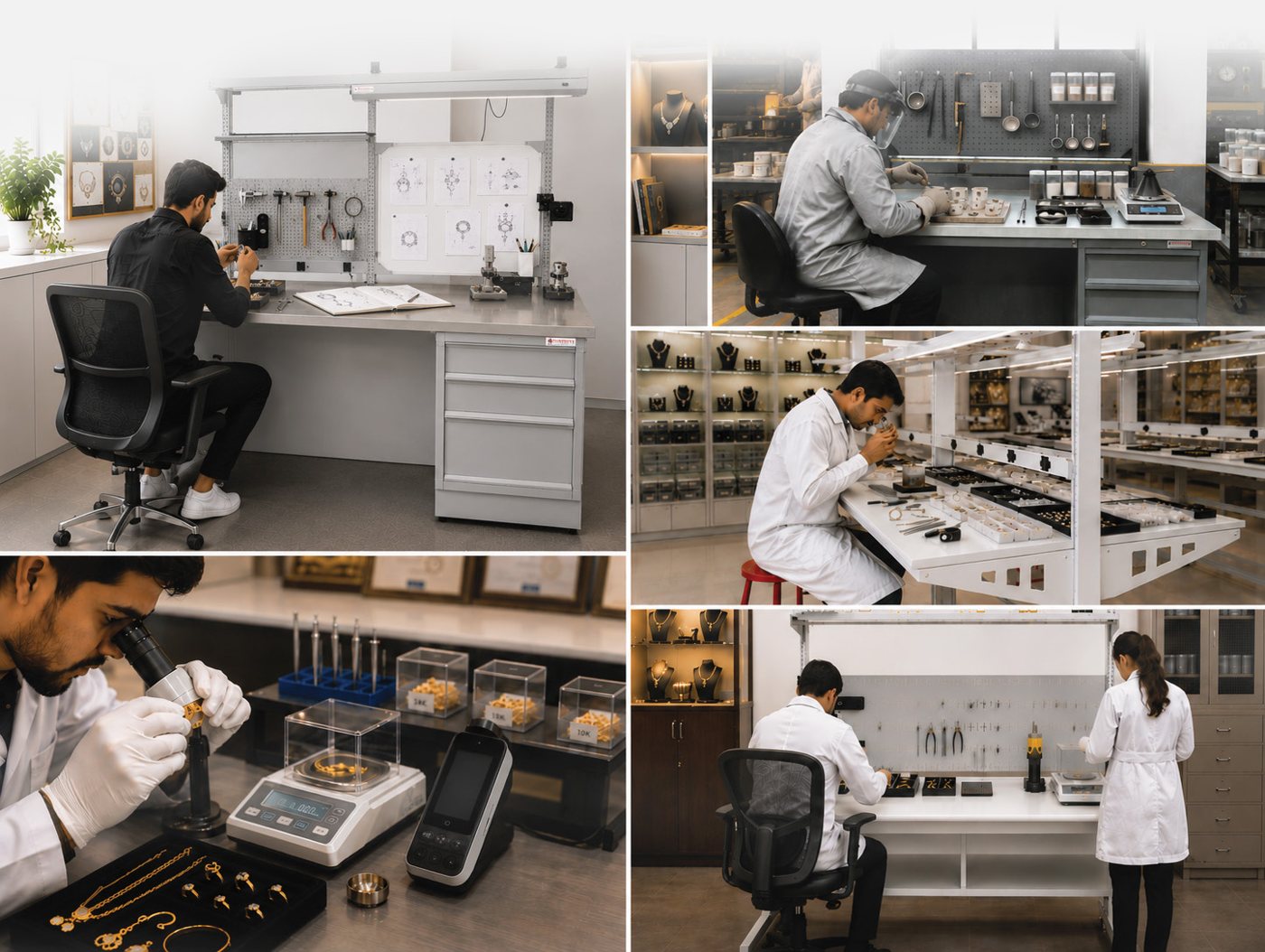
Sound familiar?
The everyday problems we hear most often from jewellery manufacturing teams.
R&D & Design Studio
Designers move frequently between digital and hand-work activities.
Melting, Casting & Powder Handling
Surfaces must with stand demanding high-temperature handling.
Wire Drawing & Metal Forming
Unstable benches can affect draw consistency.
Tool Room & Die Mould Making
Small precision tools can be difficult to locate.
11 application spaces. One configured system.
Choose a space to see the challenge, how we configure it and the systems involved.
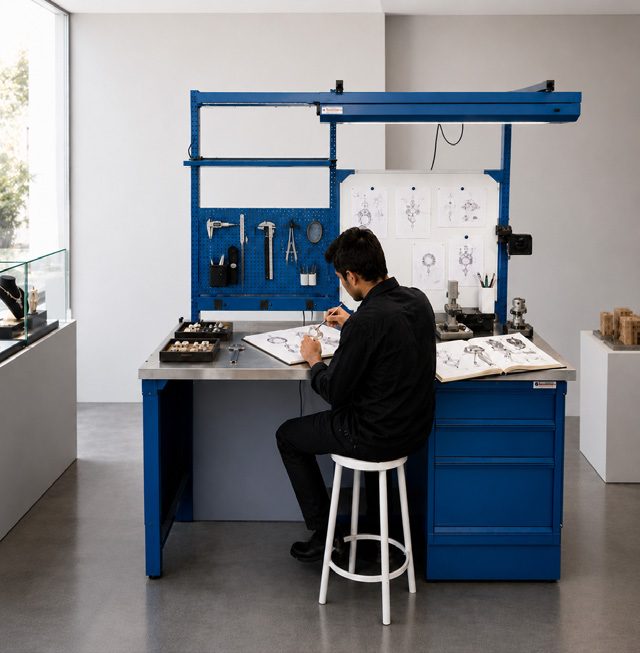
R&D & Design Studio
The design studio is where jewellery concepts move from sketching and CAD/CAM modelling to wax prototyping and sample validation. The workflow constantly shift between digital design, hand-finishing and small-batch sampling.
- Changing Work ModesDesigners move frequently between digital and hand-work activities.
- Workspace ClutterSamples, tools and reference materials can quickly occupy valuable work surface.
- Limited FlexibilityFixed furniture forces designers to adapt their workflow around the workstation.
- Sample OrganisationPrototypes and reference designs need accessible, organised storage.
- Modular & reconfigurable workstations
- Mixed digital and hand-work surfaces
- Task lighting for focused work
- Integrated cable management
- Mobile storage for samples and designs
- Faster prototyping
- Organised design workflow
- Protected sample integrity
- Smoother design-to-production handoff
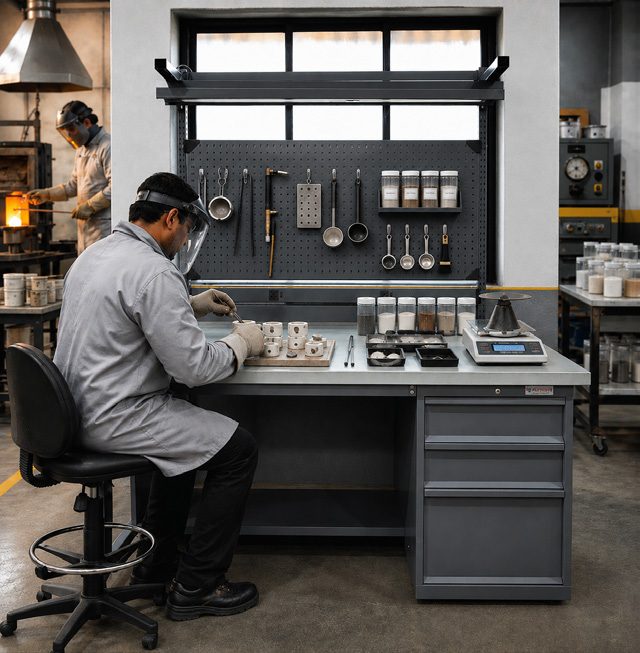
Melting, Casting & Powder Handling
Melting and casting transform gold, silver and alloy stock into ingots or rough forms before shaping. This is a high-heat, high-value environment where molten metal and powder must be handled with controlled containment and minimal loss.
- Heat & ImpactSurfaces must with stand demanding high-temperature handling.
- Fumes & ParticulatesThe workspace requires appropriate containment and ventilation.
- Material LossPowder and scrap require controlled recovery.
- Material AccountabilityPrecious-metal movement must remain traceable.
- Heat- and chemical-resistant worktops
- GI, SS cladding and HPL worktop
- Ventilated workstation zones
- Segregated powder and scrap storage
- Safer working environment
- Better process containment
- Improved fume control
- More reliable precious-metal recovery
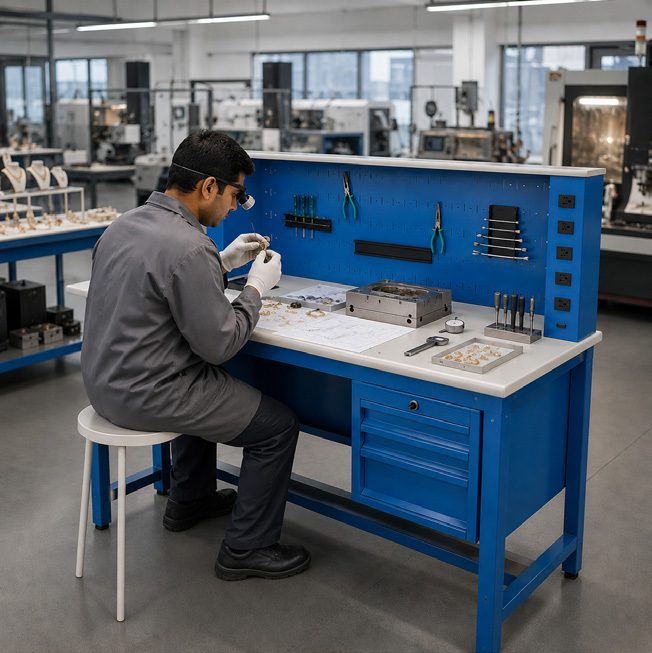
Wire Drawing & Metal Forming
Wire drawing reduces cast metal into fine wire through progressive dies, feeding chain-making and other downstream processes. The work is repetitive and physically demanding, requiring stable work surfaces and consistent die alignment.
- VibrationUnstable benches can affect draw consistency.
- Operator StrainRepetitive work demands ergonomic support.
- Die ChangeoversPoorly organised die storage slows process changes.
- Load HandlingWork surfaces must withstand metal-forming loads.
- Stable, load-rated workstations
- GI-cladded worktops
- Integrated die and tool storage
- Footrests
- Mobile die storage
- Consistent draw quality
- Faster die changeovers
- Reduced operator strain
- Organised tooling
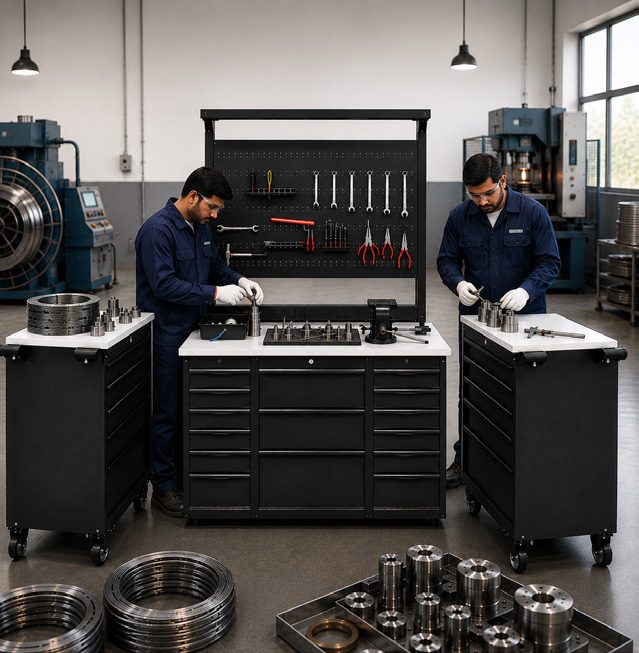
Tool Room & Die Mould Making
Tool rooms fabricate and maintain the dies, moulds and jigs that support downstream production. Precision and tool availability directly influence production continuity.
- Tool OrganisationSmall precision tools can be difficult to locate.
- Die IdentificationPoor storage increases the risk of selecting the wrong tooling.
- Changeover DelaysTime is lost searching for tools and components.
- Production DependencyTool-room inefficiencies affect downstream operations.
- Integrated tool storage
- Pegboards for frequently used tools
- Variable-angle shelving
- Mobile point-of-use storage
- Easier tool identification
- Reduced rework
- Faster changeovers
- Organised tool room
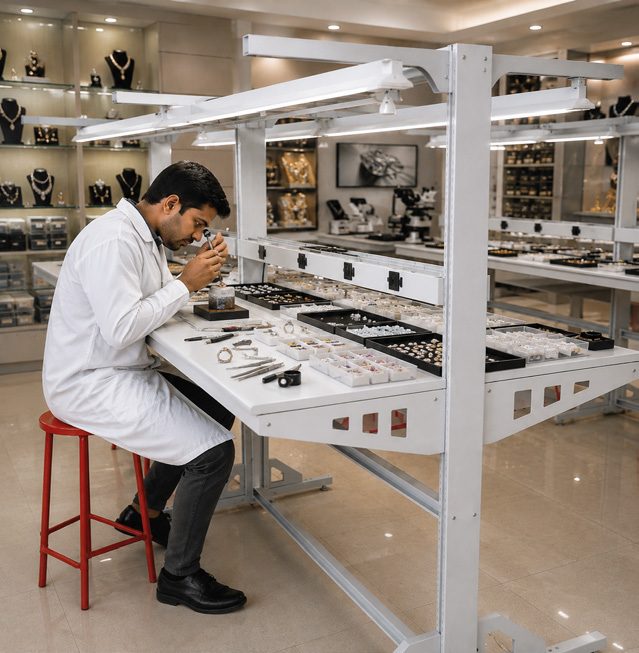
Diamond Cutting & Stone Setting
Diamond cutting, faceting and stone-setting require exceptional surface stability and focused lighting. Even minor movement can affect precision and increase the risk of losing small, high-value stones.
- Surface StabilityPrecision cutting requires a rigid work platform.
- Task LightingDetailed work requires focused illumination.
- Stone SecuritySmall stones must remain contained and controlled.
- Material LossA misplaced gemstone represents direct material loss.
- Vibration-resistant workstations
- Postform laminated worktops
- Focused task lighting
- Tray and bin systems
- Stable precision workspace
- Better lighting
- Reduced stone-loss risk
- Improved cutting consistency
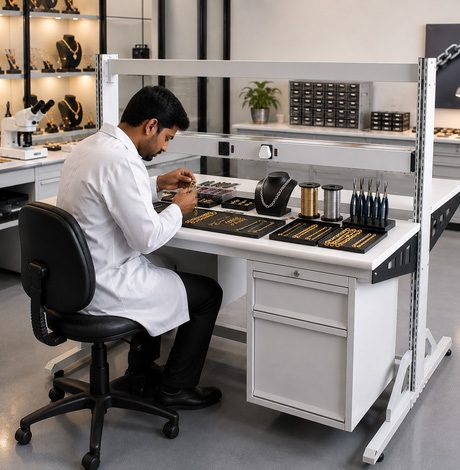
Chain Making & Assembly
Chain-making involves linking, soldering and assembling fine components into finished chains. These are high-volume, repetitive processes where space efficiency and easy tool access are critical.
- Limited SpaceChain-making stations often operate within tight production footprints.
- Tool AccessibilityFine tools and soldering equipment need to remain within reach.
- Repetitive WorkExtended seated work requires ergonomic support.
- Workspace ClutterBulky furniture can obstruct the operator's movement.
- Compact workstations
- Hanging tool drawers
- Instrument riser shelving
- Integrated power support
- Space-efficient workstation
- Tools within easy reach
- Reduced workspace congestion
- Better operator comfort
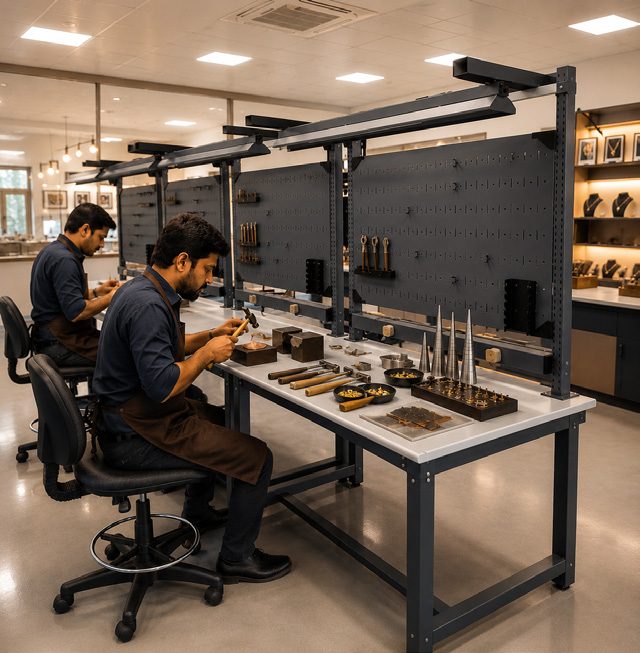
Hammering & Manual Forming Bay
Hammering and mould-based forming shape metal through manual, high-impact processes. These operations place continuousstress on the work surface and require a stable working platform.
- Impact LoadingRepeated hammering can quickly degrade unsuitable worktops.
- VibrationUnstable surfaces transfer vibration to the operator.
- Operator FatigueExtended high-impact work requires ergonomic support.
- Tool AccessibilityFrequently used forming tool need to remain within reach.
- GI-cladded impact-resistant worktops
- Integrated tool and mould storage
- Footrests
- Uprighter-mounted pegboards and shelving
- Mobile tool storage
- Durable forming station
- Better impact resistance
- Reduced operator strain
- Organised tool access
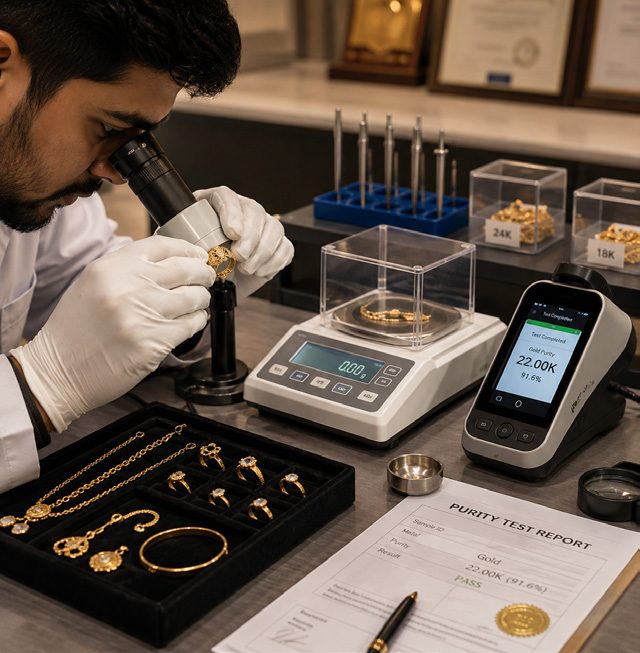
Hallmarking & Purity Certification
Hallmarking is a critical compliance check point where precious-metal purity is verified and stamped. Accuracy, sample control and documentation are as important as the physical certification process.
- Sample SegregationMixed samples create a risk of identification errors.
- Controlled SurfacesDefined work zones help prevent material mix-ups.
- Secure StoragePending and completed stock requires controlled storage.
- DocumentationRecords must remain organised and traceable.
- Stable workstations
- Segregated sample storage
- Defined surface zoning
- Documentation storage
- Controlled certification workspace
- Reduced sample mix-ups
- Secure material handling
- Audit-ready documentation
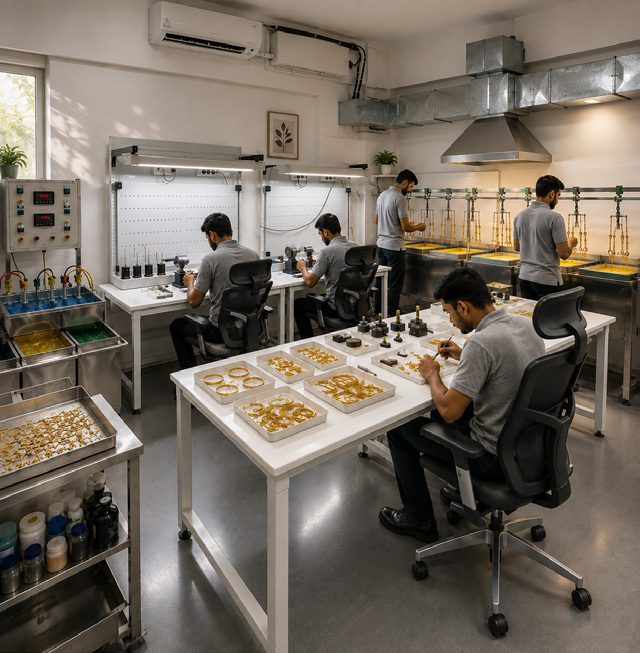
Plating & Surface Finishing
Plating and surface-treatment processes use chemical baths and solutions to apply finish coatings. These wet processes require containment, ventilation and physical separation from dry precision work.
- Chemical ExposureOrdinary surfaces can deteriorate quickly.
- Wet Process ContainmentPlating operations require controlled work areas.
- VentilationChemical handling requires appropriate ventilation.
- Cross-ContaminationWet processes must remain separated from dry finishing areas.
- Wooden worktop with SS cladding, HPL worktop
- Segregated storage for plating solutions and consumables
- Ventilated shelving
- Better process containment
- Reduced chemical exposure risk
- Cleaner wet/dry segregation
- Safer finishing environment
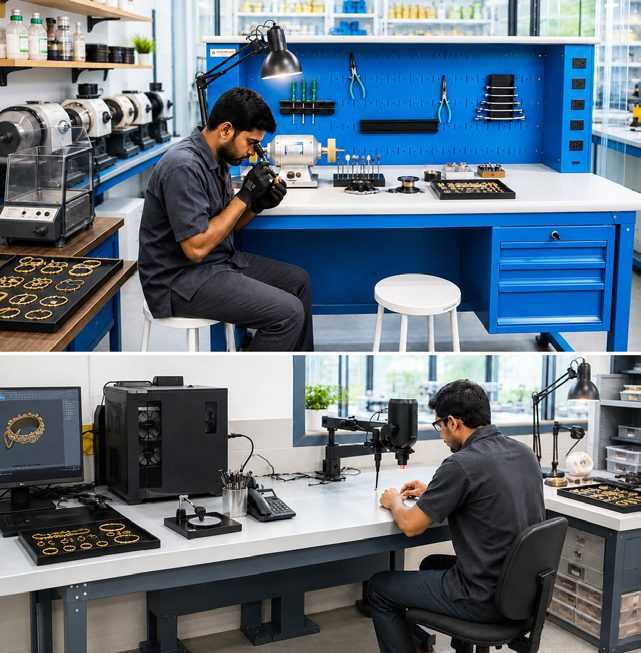
Tumbling, Polishing & Laser Marking
Tumbling and polishing refine surface finishes, while laser marking adds identification and branding details. Both are late-stage processes where surface quality and precision are critical.
- Dust & DebrisFine debris from polishing can affect adjacent precision work.
- VibrationTumbling equipment can introduce vibration into the workspace.
- Process ZoningLaser marking benefits from separation from dusty processes.
- Precision FinishingOperators need stable, organised workspaces for detailed finishing.
- Postform laminated worktops
- Rear-mounted pegboards
- Instrument riser shelving
- Laser equipment support
- Organised finishing area
- Better process separation
- Consistent surface quality
- Accurate marking
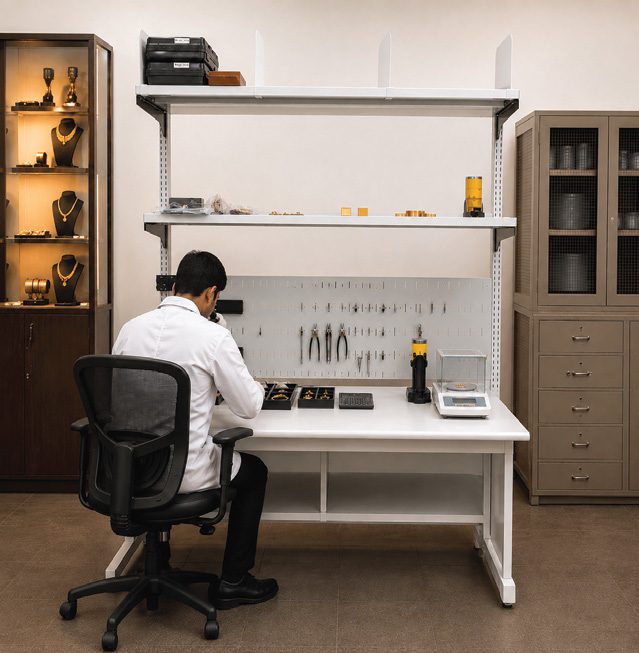
Weighing, Quality Inspection & Secure Tool Crib
This zone combines precision weighing, final inspection and secure storage of tools, consumables and in-process precious metal. It is the final control point before material moves on or off the production floor.
- Measurement AccuracyWeighing instruments require stable, controlled surfaces.
- Tool SegregationCalibrated instruments should remain separate from general tools.
- Material AccountabilityEvery movement of precious metal requires disciplined control.
- Secure StorageTools, consumables and work-in-process material require controlled access.
- Stable precision workstations
- Drawer-based tool storage
- Mobile point-of-use storage
- Accurate weighing
- Secure material handling
- Better tool accountability
- Audit-ready inspection
Fundamentals of workspace design.
- Precision
- Electrical protection
- Traceability
- Tool control
- Ergonomics
- Repeatability
- Adaptability
The Furnisys workspace ecosystem.
Work systems, storage systems and accessories designed to work as one.
Work systems

Scitec Series Technical Workbenches
An adaptable workbench series designed for diverse technical environment.

Pro Series Heavy Duty Workbench
An industrial grade workbench series designed to withstand rough work environments.

Flexi Modular Workstation System
Our most flexible workstation — designed to adapt, expand, and reconfigure effortlessly as your workspace needs evolve.

Base Series Industrial Workbench
All purpose workbench series designed to functionally serve your basic workspace needs.
Storage systems

Proof from real installations.
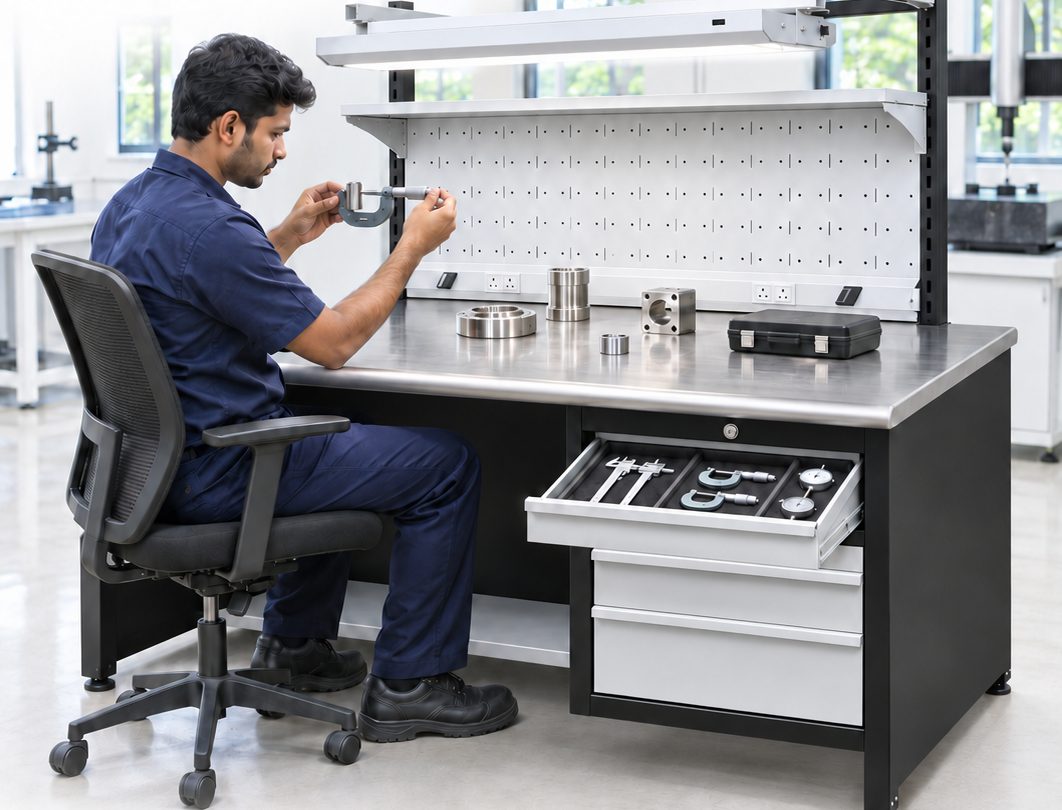
Trusted by manufacturers, laboratories and institutions across industries. See our clientele
Frequently asked questions.
Can one system cover every jewellery manufacturing space?
Yes. Work systems, storage systems and accessories share standard modules, so each space gets its own configuration within one consistent system.
Can the setup change as our operations grow?
Yes. Stations are built from standard parts, so you can add drawers, power, uprighters or bays, or relocate stations, without replacing what you already have.
Do you plan the layout before manufacturing?
For confirmed projects we carry out a site study and prepare 2D and 3D layouts and a proposal before anything is manufactured.
How we engage.
Share your brief
Scope, application spaces, timelines and any drawings.
Specialist discussion
A workspace specialist reviews the brief with your team.
Site study & layout
For confirmed projects: site study, 2D/3D layout and proposal.
Manufacture & install
Built in Navi Mumbai, installed and supported by our team.
Planning a new jewellery manufacturing space?
Share your project brief. Every brief is reviewed by a workspace specialist who will contact you to discuss scope, layout and next steps.
Application-led design
Every station configured around the process, not a catalogue.
One accountable team
Design, manufacturing and installation from Navi Mumbai.
Built to scale
Standard modules that grow with your operation.
See our latest workspace installations on LinkedIn
Follow Furnisys for new projects, application ideas and workspace insights from the workspace industry.