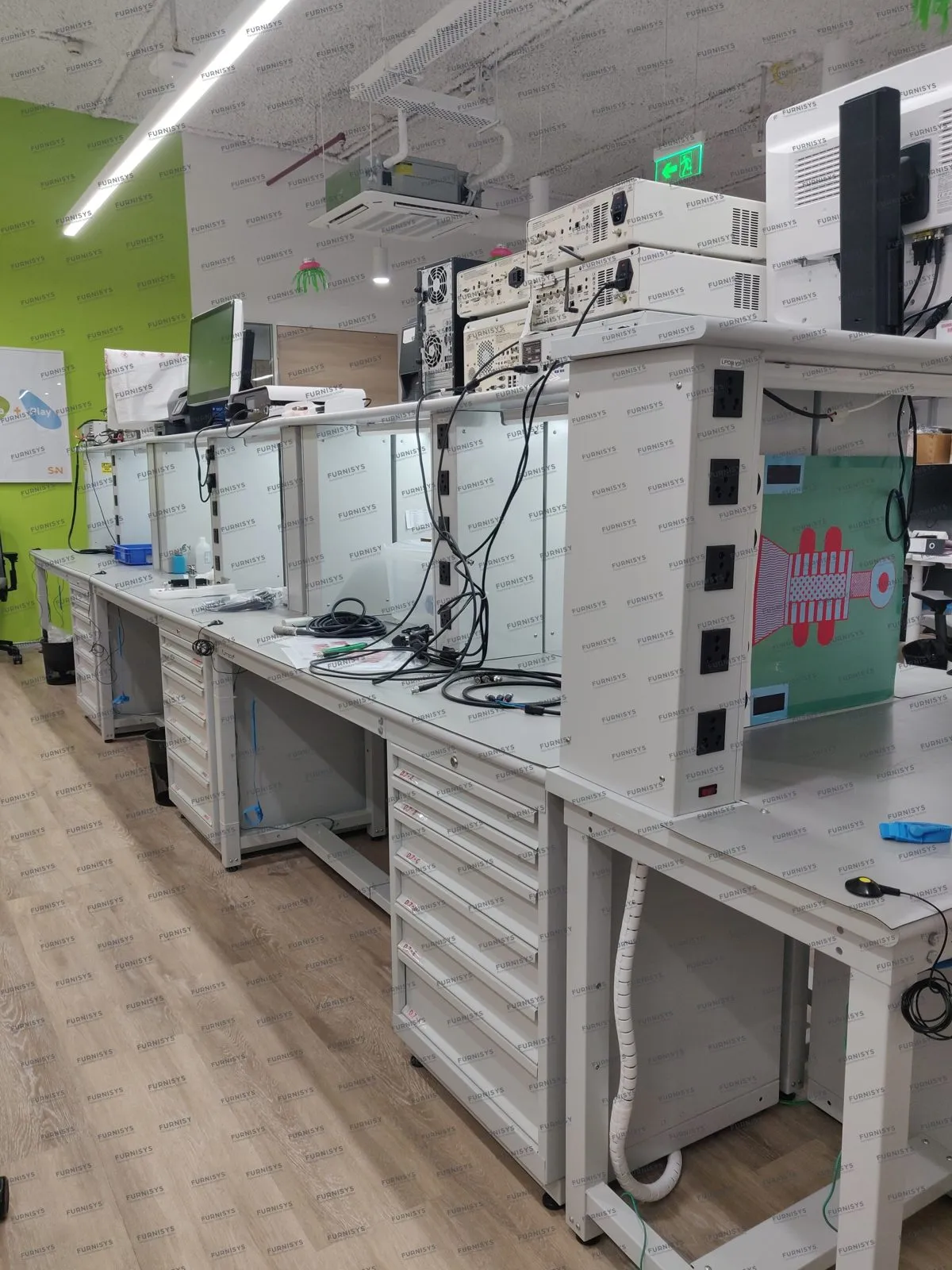
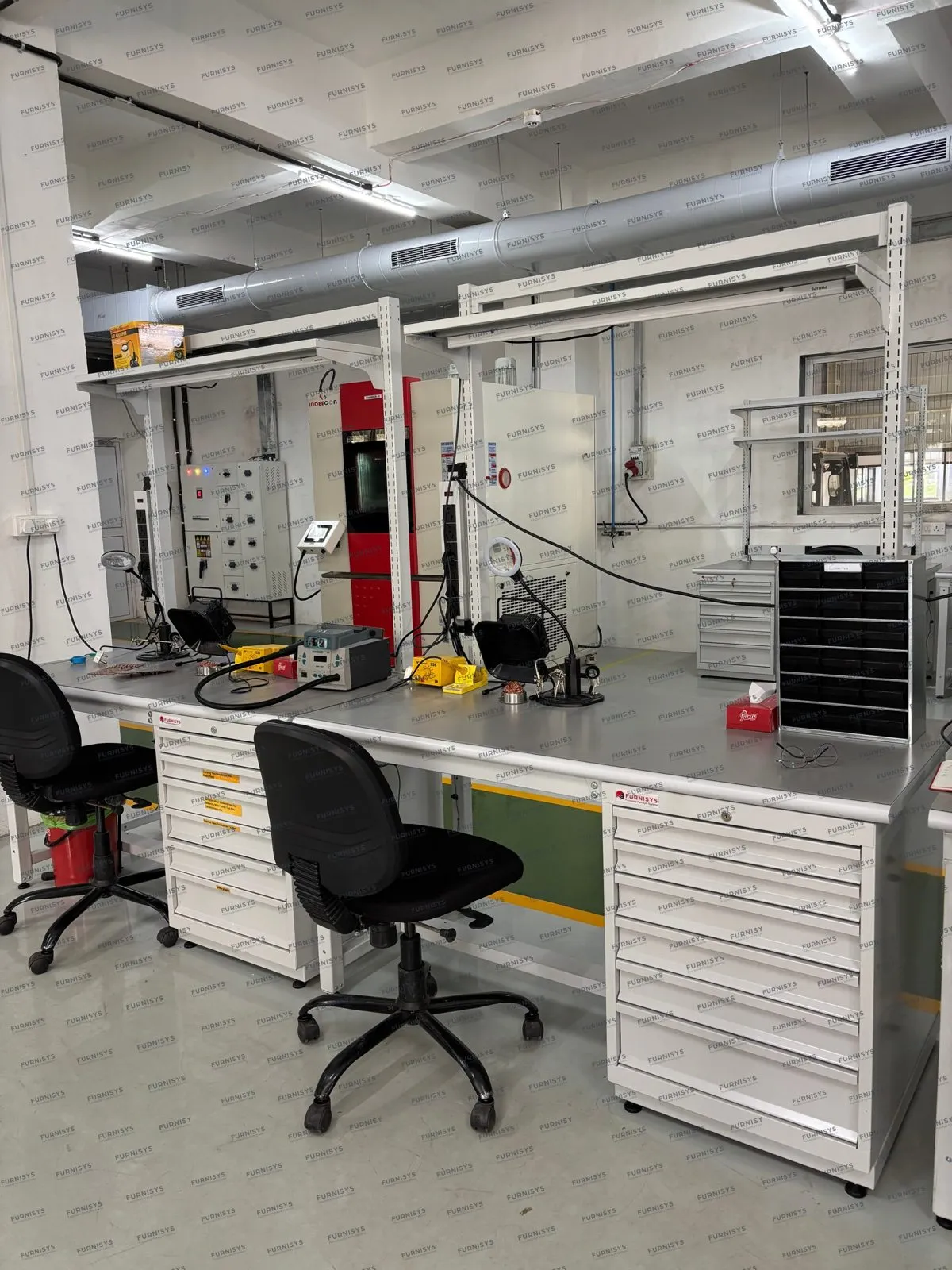
An ESD workstation needs five things: a static-dissipative worksurface with a resistance to ground below 1.0 × 10⁹ ohms; a wrist strap for every seated operator, with the whole person-to-ground path below 3.5 × 10⁷ ohms; one common grounding point that bonds the worksurface and wrist straps to the equipment ground; insulators kept away from sensitive parts; and a routine of checks, with wrist straps tested before each shift. These limits come from ANSI/ESD S20.20 and IEC 61340-5-1, the two ESD programme standards electronics customers usually audit against.
The requirements at a glance
The table summarises the main limits in ANSI/ESD S20.20-2021 (Table 1) and IEC 61340-5-1. Buy the current edition of whichever standard your customer audits you against and confirm the figures there before you write them into a specification.
| Item | What it does | Required limit | Check |
|---|---|---|---|
| Worksurface (worktop or mat) | Drains charge from parts placed on it | Below 1.0 × 10⁹ Ω to the groundable point and point to point | At installation, then on your compliance-verification schedule |
| Wrist strap system | Grounds a seated operator | Below 3.5 × 10⁷ Ω, person to ground | Before each shift, or use a continuous monitor |
| Footwear and flooring | Grounds a standing operator without a strap | Below 3.5 × 10⁷ Ω, or below 1.0 × 10⁹ Ω with body voltage under 100 V | On entry to the ESD area |
| Seating | Stops a chair from holding charge | Below 1.0 × 10⁹ Ω to ground | Periodically |
| Equipment grounding conductor | The ground every item bonds to | Below 1.0 Ω impedance; an auxiliary ground below 25 Ω to it | At installation, by an electrician |
Who has to be grounded, and how
People are the largest source of static at an assembly bench, so the standard starts with them.
- Seated operators must wear a wrist strap connected to the bench's grounding point.
- Standing operators can use a wrist strap, or ESD footwear on an ESD floor that meets the limits above.
- The wrist strap cord carries a current-limiting resistor, typically 1 megohm, so the operator is protected if they touch a live conductor.
- The worksurface gets its own ground cord to the common point. Do not ground a mat through an operator's wrist strap.
Plan one wrist-strap point per operator position. On a double-sided line that means points on both faces of the bench.
Choosing the worksurface: ESD worktop or ESD mat
The worksurface is what the parts touch, so it is the first thing to specify. There are two ways to make it ESD-safe:
| Built-in ESD laminate worktop | ESD mat on a standard worktop | |
|---|---|---|
| At Furnisys | 36 mm postform electrostatic laminate (PELW) with grounding points | Grounded ESD mat on a PLW, HPL or other worktop |
| Best for | Benches that stay in the ESD area for good | Benches that may move between ESD and non-ESD work |
| Watch for | Damage to the laminate edge, which should be repaired, not covered | Mats curling or getting covered with non-ESD sheets, and loose ground cords |
Whichever you choose, ask the supplier for the measured resistance of the worksurface and the test method (ANSI/ESD STM4.1 or IEC 61340-2-3), then measure it yourself when the bench is installed. Worktops for every industry compares PELW with the other worktops in the range.
The grounding path at the bench
Every conductive item at the station should end at one common grounding point, which connects to the equipment ground. On a Furnisys ESD workstation the wrist strap and ground block mount beneath the worksurface, so the operator, the worktop and any mat share one point.
- Equipment ground (from the building's earthing, checked by an electrician).
- Common grounding point on the bench.
- Separate cords from that point to the worksurface and to each wrist-strap socket.
- Metal shelves, uprighters and power rails on the bench bonded to the same frame.
Mark the grounding point and the ESD area clearly, so a new operator knows where to plug in and where the controlled area starts.
Insulators and everything else in the ESD area
Common plastics cannot be grounded, so a grounded bench does not drain them. Inside the ESD area:
- remove what the process does not need: bubble wrap, foam cups, plastic files, ordinary tape dispensers;
- use static-dissipative bins, trays and tote boxes for parts, not standard plastic ones;
- keep plastics the process does need, such as some fixtures or housings, away from sensitive parts, or neutralise them with an ioniser;
- keep sensitive parts in ESD packaging until they reach the bench.
Plan storage at the same time as the benches. Drawer cabinets, bins and shelves that feed the line are part of the ESD area.
A workbench cannot make you compliant on its own
ANSI/ESD S20.20 and IEC 61340-5-1 are programme standards. They expect a written ESD control plan, training, a compliance-verification schedule and records, as well as compliant equipment. A supplier can give you a bench that meets the worksurface and grounding requirements. Your quality team still owns the programme and the audits.
So when a quotation says "ESD workstation", ask for:
- the worktop or mat material, and its measured resistance with the test method;
- the grounding hardware included: ground block, wrist-strap sockets, cords;
- where the common grounding point sits and how it connects to your earthing;
- which accessories are metal and bonded, and which bins are static-dissipative.
Building an ESD line in a manufacturing plant
Most electronics plants need more than one kind of ESD bench. Furnisys builds them from one system, so ESD lines, test benches and storage share a frame and an accessory standard:
- Assembly lines: Flexi starter and adder units, single- or double-sided, extended as volumes grow. An EV charger R&D lab runs twelve users on back-to-back Flexi workstations with ESD mats (case study).
- Test, calibration and R&D: Scitec workbenches with instrument riser shelves, as in an ESD-safe medical equipment testing lab (case study).
- Heavy units: Base workbenches, rated up to 454 kg evenly distributed load. A naval systems R&D lab uses one with an ESD mat, wrist strap and grounding block (case study).
- Soldering and packing: a PPE lighting maker uses one ESD-safe Link Workstand for soldering LED PCBs and a second configuration for packing (case study).
See every electronics space we configure, from progressive assembly to repair benches, on electronic assembly workstations and storage.
Checklist to send with your enquiry
- The standard you audit to: ANSI/ESD S20.20 or IEC 61340-5-1.
- Number of operator positions, seated or standing, single- or double-sided.
- Worksurface: built-in ESD laminate or grounded mat.
- Heaviest item on the bench, in kg, and bench sizes in mm.
- Accessories: uprighters, shelves, power rails, lights, bins, drawers.
- Where the earthing point is in the room, and a floor plan if you have one.
Send it through Request a consult or attach it to a quote request on the ESD workstations page. Our team returns a 2D/3D layout and drawings of the configuration.
Frequently asked questions
What is an ESD workstation?
An ESD workstation is a workbench where static charge is drained safely to ground instead of discharging into electronic parts. It has a static-dissipative worksurface, a grounding point, and a wrist strap connection for the operator, all bonded to the equipment ground.
What resistance should an ESD worksurface have?
Under ANSI/ESD S20.20 and IEC 61340-5-1, the worksurface should measure below 1.0 × 10⁹ ohms to its groundable point and point to point. Ask your supplier for the measured value and the test method used.
Do standing operators need a wrist strap?
Seated operators must wear a wrist strap. Standing operators can be grounded either by a wrist strap or by ESD footwear on an ESD floor, where the person-footwear-floor path is below 3.5 × 10⁷ ohms, or below 1.0 × 10⁹ ohms with a body-voltage test under 100 V.
Is an ESD mat enough, or do I need an ESD worktop?
Both work if they are grounded and meet the resistance limit. A built-in ESD laminate worktop suits benches that stay in the ESD area permanently. A grounded ESD mat on a standard worktop suits benches that may move between ESD and non-ESD work.
Which standard should my ESD workstation meet?
Use the ESD control programme your customers audit you against, usually ANSI/ESD S20.20 or IEC 61340-5-1. Both cover the whole programme, including training, grounding, checks and records, so a workbench supports compliance but cannot provide it on its own.
Does Furnisys make ESD workstations in India?
Yes. Furnisys designs and makes ESD-safe workstations in Navi Mumbai and supplies them across India. ESD worktops and grounding accessories are available on the Scitec, Base and Flexi series.